The Matterhorn of Africa

Updated: 2 hours ago
First-time visitors to Namibia tend to frequent a handful of must-see sites such as the Etosha National Park, Sossusvlei, or the Skeleton Coast. And while no one should depart Namibia without trying his luck at spotting a white rhino in Etosha, admiring the red sands of the Kalahari, or pondering the arresting beauty of dark grey peaks of Namib-Naukluft, many travelers needlessly skip less well-known but equally rewarding locations. Chief among them is a rock formation known as Spitzkoppe — a landmark so mesmerizing that it earned the nickname "The Matterhorn of Africa."
I first spotted Spitzkoppe on the horizon in March 2015, when traveling from Windhoek, Namibia's capital, to Swakopmund, a coastal city with quaint reminders of German colonialism. Like most first-timers, I paid insufficient attention to what is happening on either side of the road, dreaming of reaching Swakopmund's beaches (not realizing that the Benguela Current makes the waters of southeastern Atlantic bitterly cold all year round). Much of the drive leads through semi-arid savanna with grassland and scattered thorn trees. Not quite desert yet but dry and rugged, with stony hills and serrated mountains towering on the horizon.
Unlike what driving instructors might recommend in duller locales, paying attention to both the road and its surroundings is the safe approach here. Especially early risers might spot a kudu, an oryx, and certainly numerous guinea fowl, which like to jump under passing vehicles. Roughly ten minutes after passing the rail hub of Usakos, a strange jagged silhouette appears to the right of the B2 road. Take a right turn onto the D1918 gravel road and what resembles an otherwordly contour slowly turns into a cluster of granite inselbergs.

source: photo archive of the author (September 2026)
"Inselberg" is German for an isolated hill or mountain that rises abruptly from otherwise flat surroundings. Literally translated as an "island mountain," the term describes Spitzkoppe perfectly. The granite forming the Matterhorn of Africa is more than 120 million years old, with the highest peak reaching about 1,728 meters above sea level and about 700 meters above the desert floor. The massif formed when molten rock intruded beneath the surface during the breakup of Gondwana. Millions of years of erosion eventually exposed the granite core beneath. Although humans have lived around Spitzkoppe for thousands of years, legend has it that the first European attempting to climb the peak was a soldier of the German Imperial Schutztruppe in 1904. Supposedly he never made it back but there is no proof and the story might be entirely apocryphal.

source: photo archive of the author (September 2026)
The Spitzkoppe complex is made up of several parts. Groot Spitzkoppe (pictured immediately above and below) is the towering main peak. Several kilometers away sits the smaller Klein Spitzkoppe, which is typically ignored by most visitors. Another notable peak is Sugarloaf, so named because of its conical shape.

source: photo archive of the author (September 2026)
Groot Spitzkoppe is flanked by a cluster of additional granite domes nearby, known as the Pontok Mountains (image below).

source: photo archive of the author (March 2015)
At the eastern end of the Pontoks is a unique rock art site known as "Bushman's Paradise," featuring San paintings of animals and human figures. A short drive from the main gate, the site is reached by scaling a rock face fitted with a chain to assist visitors. During most of my visits, a guide was available to lead the way and share insight into the paintings' history. The San artists used naturally occurring pigments, including ochres and other mineral materials, to produce the paintings. One of the guides told me the paintings are estimated to be 4,000 years old.
As far as we know, the San were the first people to live around Spitzkoppe. They were hunter-gatherers, moving with the seasons to follow water and game. They hunted kudu and oryx with bows and arrows and used local granite overhangs for shelter. That way of life would eventually be disrupted by other groups who passed through the area. Today, most San in Namibia live in scattered communities across the country's north and east, far from Spitzkoppe itself.

source: photo archive of the author (September 2026)
Spitzkoppe is worth visiting year-round, but the best time is between April and September, when temperatures are far more manageable. Outside this window, it gets brutally hot. So hot that touching the sun-baked rocks can be genuinely unpleasant. It also makes climbing and exploring the area a little less enjoyable. I have visited Spitzkoppe five times now, four times as day trips and one extended weekend camping at one of the nearby campsites. There are also cabins and a fancier lodge for those who want to spend a bit more money. Personally, I find that unnecessary because I visit Spitzkoppe to reconnect with nature, not to seek material comfort. Like everything in this part of Namibia, the properties are sufficiently spaced out and the number of visitors is generally very small. Staying overnight has the benefit of experiencing the night sky, which is spectacular. To catch the inselbergs' uniquely orange hues, it is ideal to be on site in the early morning light.
source: photo archive of the author (March 2015)
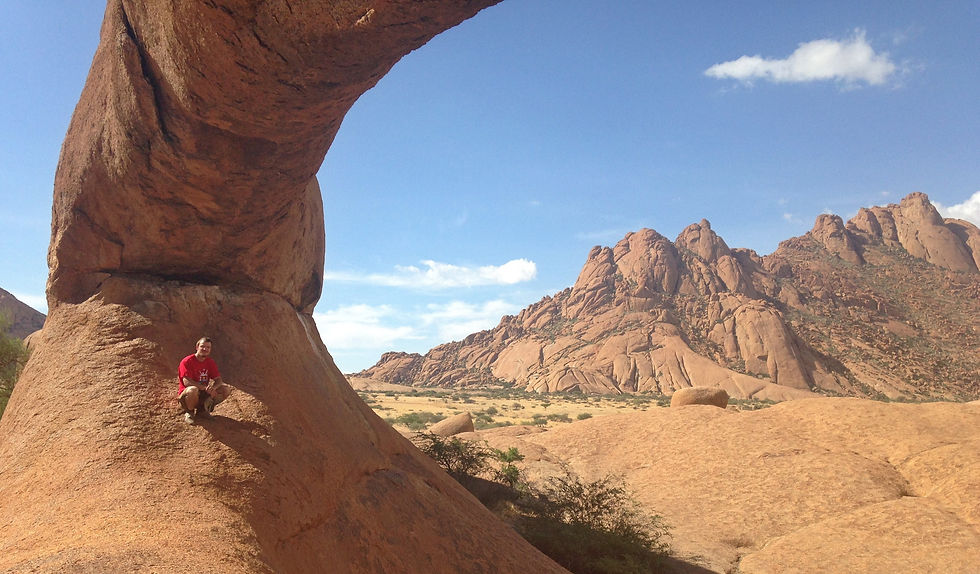
One of the most photographed attractions is Spitzkoppe's Rock Arch, which offers spectacular sunrise views.

source: photo archive of the author (June 2021)
Exploring Spitzkoppe is an endless adventure. The area is scattered with small rock pools arranged in idiosyncratic formations. It really gives one the impression that someone simply arranged the rocks for fun.

source: photo archive of the author (June 2021)
Despite the arid conditions, Spitzkoppe supports a surprising number of plants. Species like quiver trees and acacias cling to the rocky terrain. Although they typically hide in midday heat, mountain zebras, springbok, kudu, and oryx also occasionally pass through. Various types of colorful lizards are everywhere, too.

source: photo archive of the author (September 2026)
Many of adjacent rocks in the Spitzkoppe area can be climbed on foot and offer breathtaking vistas. That said, initially mild slopes can steepen quite suddenly and one has to know when to turn back. Excessive confidence backfires. I have seen my share of cocky tourists sliding back on their rear because they misjudged the slopes.

source: photo archive of the author (June 2021)
Sugarloaf rises dramatically above the surrounding desert plains, unveiling a stunning view of Klein Spitzkoppe in the background (image above).

source: photo archive of the author (September 2026)
One of my favorite activities at Spitzkoppe is to find a quiet spot with a stunning panorama, take in the landscape, and meditate.

source: photo archive of the author (September 2026)
I have discovered that the combination of natural beauty and human solitude at Spitzkoppe has a profoundly cathartic effect on the human psyche. Surveying the endless plains below sparks a strange sense of familiarity, even though this place seems so different from the lives most of us lead day to day. But nothing could be further from the truth. For most of human history, this was our world. Open land, wide skies, and stillness interrupted only by the wind. In that sense, paying Spitzkoppe a visit is not just about exploring something new. It is about rediscovering what has always been there. It is about returning home.


Comments